You find the perfect source for a report. The article explains exactly what you need, the data supports your argument, and the author provides a useful explanation that ties everything together. You bookmark the page, copy a few notes, and move on to the next task. Problem solved, right?
- A Bookmark Remembers the Address, Not the Evidence
- When Your Notes Outlive Their Sources
- Build an Evidence Trail You Can Actually Follow
- Choose a Record That Matches the Information
- Organize Sources Around the Work They Support
- Make Your Future Self's Job Easier
Not quite.
A few weeks later, you return to that source. The article has been updated, the original paragraph is gone, or the website no longer loads. Your notes still contain the key takeaway, but you can no longer confirm the details that made the information useful in the first place.
This is the uncomfortable side of online research: finding information is easy, but preserving the context behind it takes a little more thought. Whether you're writing an academic paper, preparing a business report, building a presentation, or collecting material for a long-term project, your research is only as useful as your ability to revisit and verify it.
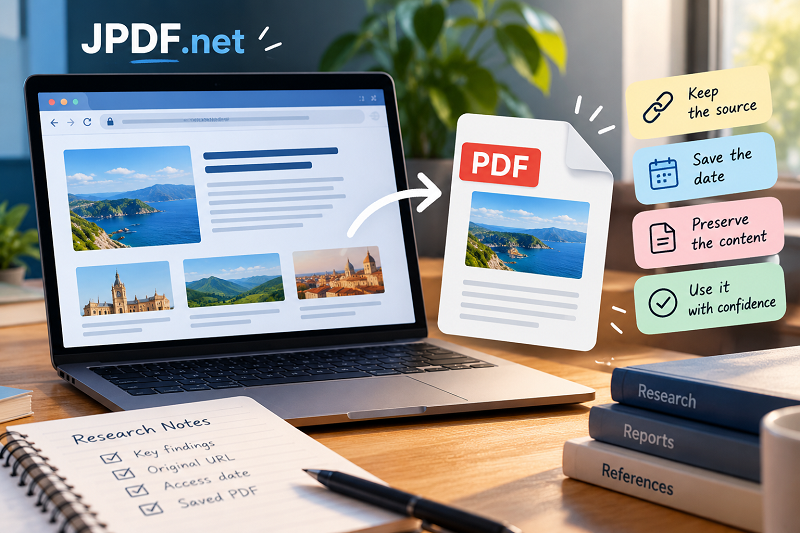
A Bookmark Remembers the Address, Not the Evidence
Bookmarks are great for getting back to websites. They're not designed to preserve the exact information you saw when you first visited a page.
Online content changes for all kinds of reasons. Publishers revise articles, companies update product specifications, government agencies replace documents, and websites reorganize their pages. Sometimes the original content disappears entirely. Even when a link still works, it may lead to a version that no longer supports the conclusion you recorded earlier.
Browser history has a similar limitation. It can help you locate a page you visited, but it doesn't necessarily preserve the page's previous content. And a copied URL tells you where the information came from, not what the source actually said at the time.
That's why serious research needs more than a growing collection of browser tabs. You need a record that connects the original source, the information you used, and the reason it mattered to your work.
When Your Notes Outlive Their Sources
Imagine preparing a quarterly market report using figures from several industry websites. You record the numbers, summarize the trends, and build a presentation around your findings. Everything looks solid until a colleague asks where one particular figure came from.
You find the URL, but the page has been updated. The number is different, and the original explanation is nowhere to be found. Now you're spending time reconstructing research that you already completed.
The same problem shows up in academic work, journalism, competitive analysis, and everyday office projects. A student may need to verify a quotation before submitting a paper. A journalist may want to compare an original statement with a later revision. A marketing team may need to understand why a campaign recommendation was based on a particular statistic.
In each case, the problem isn't simply a missing file. It's a broken connection between a conclusion and its supporting evidence.
The longer a project runs, the more expensive this disconnect becomes. Rechecking sources consumes time, weakens confidence in old notes, and can force you to repeat work that should have been finished already.
Build an Evidence Trail You Can Actually Follow
A useful research archive doesn't have to be complicated. The goal isn't to save every page on the internet or create a folder for every passing idea. It's to make important sources identifiable, understandable, and easy to retrieve.
Start by recording the original URL, page title, author or publishing organization when available, and the date you accessed the information. These details help you identify a source even if its address or content later changes.
Next, capture the specific information that influenced your work. That might be a statistic, a quotation, a definition, a product specification, or an explanation of a trend. Add a short note describing how you used it. A number saved without context can become surprisingly difficult to interpret months later.
For sources that are especially important, keep a local reference copy when permitted. A saved document gives you something concrete to revisit without depending entirely on the live website. Keep the source URL and access date alongside that copy, rather than assuming the downloaded file will tell the whole story.
Finally, establish a naming system that makes sense outside your own memory. A filename such as market-report-source-2026-10-12.pdf is more useful than document-final-new-2.pdf. Consistency may not feel exciting, but neither does spending twenty minutes searching for a file you saved yesterday.
Choose a Record That Matches the Information
Not every source needs the same preservation method. A bookmark may be enough for a frequently updated dashboard you check every morning. A spreadsheet may work better for collecting figures from multiple sources. A screenshot can capture a particular visual element, while a written citation preserves the information needed to identify and reference the original publication.
For a longer article, online report, or research page, a PDF can be a practical middle ground. It creates a portable document that you can read, organize, annotate, and share without asking someone else to navigate the original website.
When the material is presented as a web page, a tool such as htmltopdf can help turn HTML-based content into a PDF document for reference. This can be useful when you want a readable local copy of an article or a web-based document as part of your research archive.
There is one important distinction, though: a saved PDF is a reference copy, not an automatic guarantee of authenticity. Interactive charts, embedded videos, login-protected material, and dynamically loaded content may not be preserved completely. A PDF also doesn't prove when a page existed or whether its contents were later altered.
For high-stakes research, retain the original URL, record the access date, and follow any applicable citation, licensing, and archiving requirements. If you need independently verifiable historical evidence, consider a suitable web-archiving service or a formal records-management process rather than relying on a downloaded document alone.
Organize Sources Around the Work They Support
Collecting files is only half the job. The other half is making sure those files remain useful after the project becomes less familiar.
Instead of organizing everything by file format, consider grouping research by project, subject, or report. Keep the original source information close to the saved document, and use a consistent reference system in your notes. If several documents support one conclusion, make those relationships explicit.
It also helps to distinguish between the source itself and your interpretation of it. A saved article may contain the original claim, while your notes explain how that claim relates to your analysis. Keeping the two separate reduces the risk of accidentally treating your own summary as a direct quotation or overlooking a change in the source's meaning.
For collaborative work, agree on a shared naming convention and storage location before the folder fills up. A simple index containing the source title, URL, access date, relevant finding, and saved-file location can make a surprisingly large research collection manageable.
Most importantly, don't wait until a source disappears to decide whether it was worth preserving. Capture essential references while you're actively using them, when their context is still fresh.
Make Your Future Self's Job Easier
Good research isn't just about finding the right answer today. It's about being able to explain where that answer came from tomorrow, next month, or when someone challenges it six months later.
A thoughtful evidence trail helps you revisit decisions, verify claims, update reports, and collaborate without repeatedly starting from scratch. It also makes your work more transparent: another person can understand which sources informed your conclusions instead of having to trust a collection of unexplained notes.
You don't need an elaborate digital archive to get started. Record the source details, preserve important material when appropriate, and connect every saved document to the work it supports. Small habits like these can prevent major headaches later.
If online articles and web-based documents are a regular part of your workflow, make saving useful reference copies part of your research routine. With JPDF.net, you can access free online PDF tools to help prepare and manage documents for your projects.
The internet will keep changing. Your research process should be ready for that.